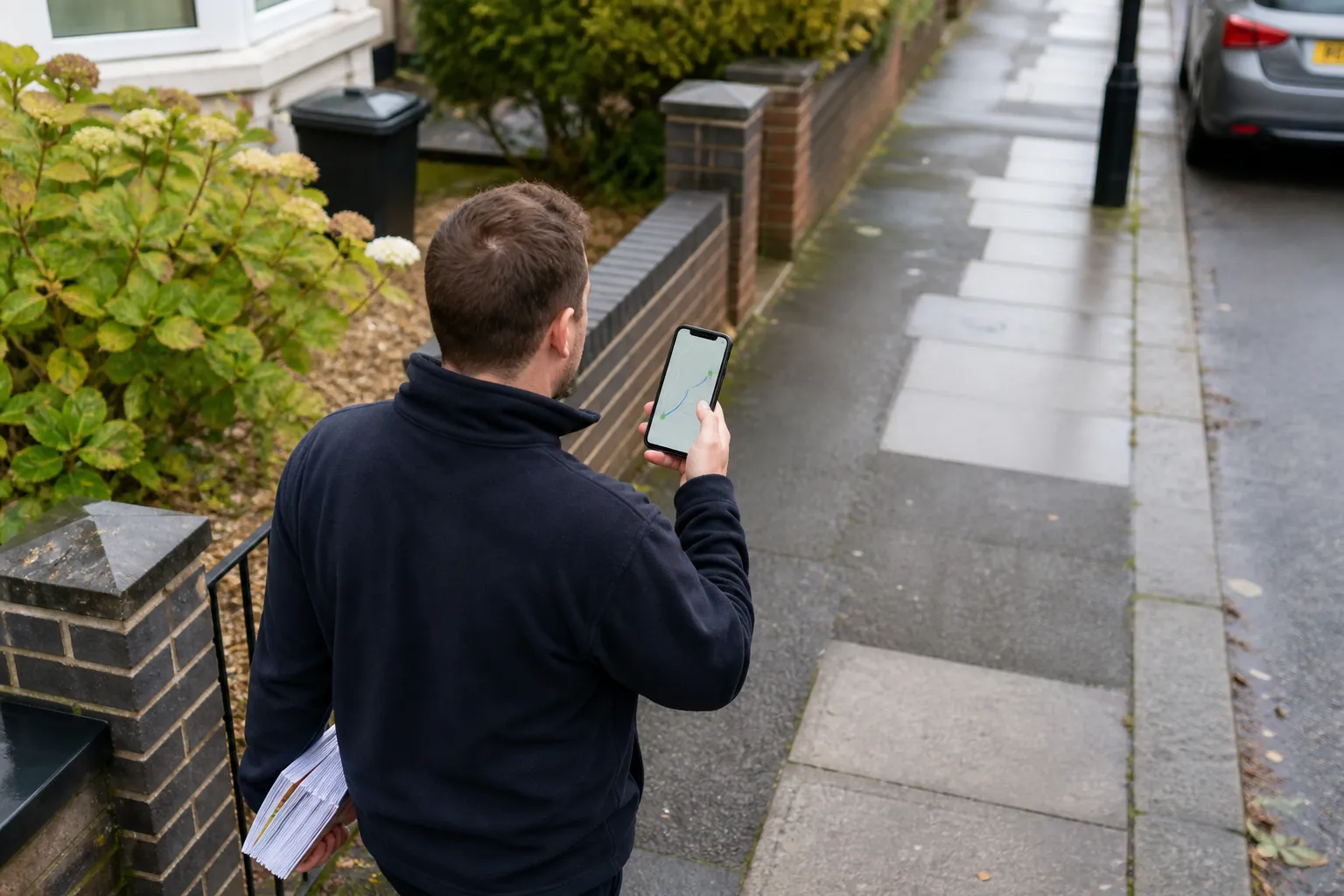
Delivery evidence is central to a successful door-drop campaign. It provides reassurance that the planned area was covered, supports client reporting and creates a clearer answer when a question arises. Live GPS tracking and static screen grabs are not equivalent forms of evidence.
What live GPS tracking provides
Live tracking shows delivery activity as it happens. It can record route movement and timing, helping a team see whether a route is being followed and respond promptly to unexpected delays or deviations. This ongoing view creates accountability during the campaign, rather than only afterwards.
Why a screenshot is limited
A screen grab is only a snapshot of a point in time. It may be useful as a visual reference, but it cannot show the full sequence of activity or demonstrate what happened before and after the image was taken. It offers less context when delivery needs to be verified.
Benefits for campaign management
- Immediate intervention: issues can be identified while a route is active.
- Clearer reporting: time and location data create a more complete delivery record.
- Better route planning: live and completed route information can reveal practical efficiencies.
- Improved communication: clients receive more useful evidence of campaign progress.
- Stronger dispute handling: a detailed record can help answer questions with confidence.
Transparency for clients and communities
Where a distribution is tied to an important public notice or a time-sensitive campaign, confidence in delivery matters. A record that is dynamic, timestamped and tied to the route gives more assurance than a single static image.
Tracking should support good delivery practice, not replace it. The strongest operations combine clear maps, trained teams, supervision and transparent reporting.
Choosing a dependable delivery partner
Ask what evidence will be available during and after distribution, how inaccessible properties are reported and how any issue is handled. A transparent process makes it easier to assess a campaign on more than assumption.
Talk about tracking